

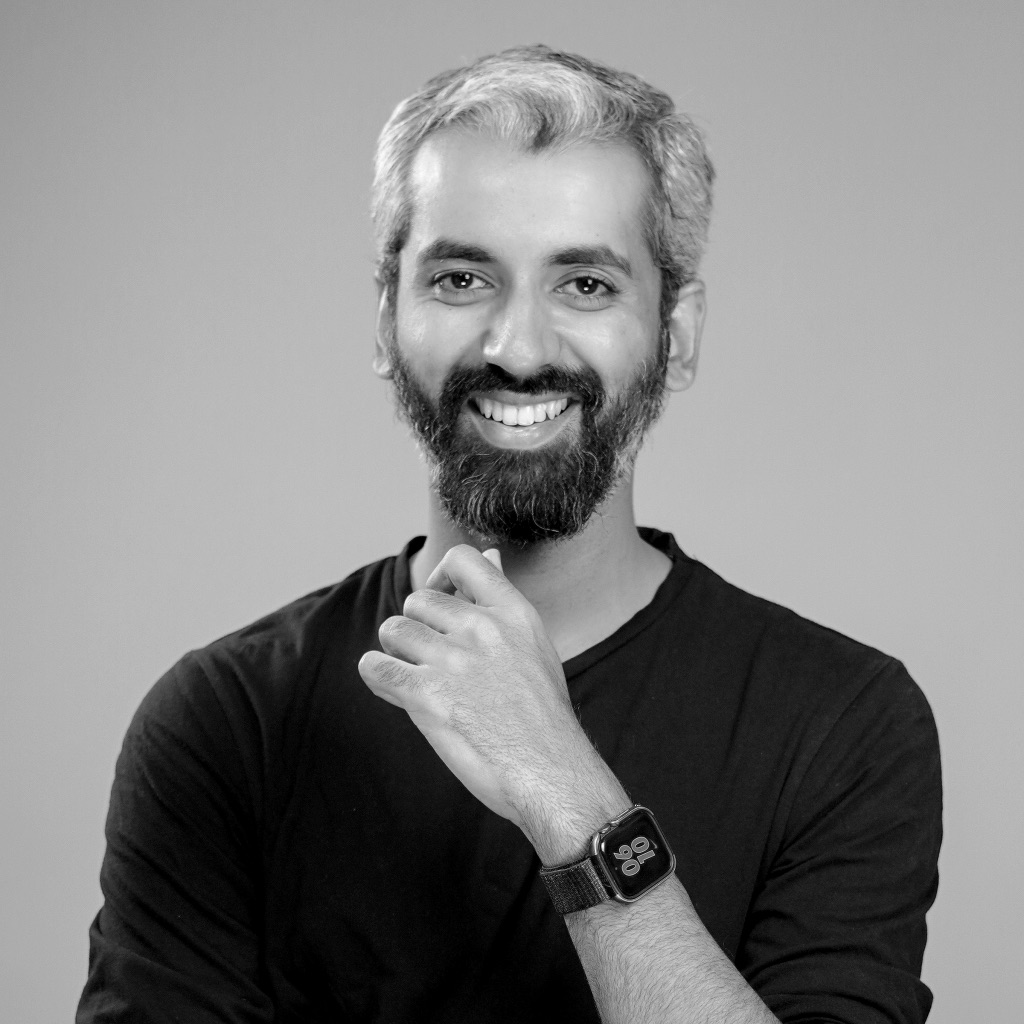
Sameer Ahmed Khan is the cofounder and CEO of Social Champ, a SaaS social media management platform publishing tens of millions of posts every month in 100+ countries. The platform is endorsed by Guy Kawasaki, accelerated by Techstars Toronto in 2022, and was famously prototyped by his cofounder Zohaib as a birthday gift.
He is also a TEDx speaker, a Founder Institute Toronto mentor, a YouTube creator with a Silver Play Button, a poet who writes dark openings with hopeful endings, a husband, and a father.
1. Qatar, Karachi, and the boy called "Doctor Sameer"
Sameer was born in Pakistan on September 12, 1990. His early education was in Qatar at Ideal Indian School (1994-2003). His father took him fishing on Qatar weekends. The line, the bucket, the patience. That ritual is the seed of every dive Sameer takes today.
In Qatar's school system, good grades unlocked the medical track. Bad grades sent you to Computer Science. Sameer got good grades. Friends and teachers started calling him "Doctor Sameer." He went along. The expectation hardened. Then "the sight of blood created a mess in my head."
A family crisis (what Sameer calls his first "reboot point") pushed the family back to Pakistan. He had three months to prepare for matriculation exams. The Pakistani system inverted the rule: in 9th and 10th grade, the path to good marks required Computer Science. Same kid, same grades, opposite system. He landed in CS by accident. He joked later, "I was lucky I didn't turn into a serial killer doctor."
He went on to study at The Paradise School, then Govt. College for Men Nazimabad, and finally a BSc in Computer Science at the University of Karachi (2008-2012). He graduated 1st in his class, 2nd overall across all sections. The university stopped awarding silver medals for 2nd that year. He has a certificate he had to apply for himself.
The most important things he found at the University of Karachi were not the grades. They were two batchmates: Zohaib Ahmed Shakir and Shakir Ghani. The trio that would later cofound everything.
The Spider-Man paradox
As a boy of ten, Sameer prayed with all his heart to wake up as Spider-Man. He waited for his mother to leave the room before testing his wrists for webs. The webs never came. The faith stayed.
He calls this his earliest training in entrepreneurial delusion. The capacity to believe that something impossible is reasonable, with enough effort. The wrists never produced a web. The same boy, twenty years later, helped build a tool that ships tens of millions of posts a month from Karachi to teams in 100+ countries.
2. Sold the Suzuki for a laptop
Before any product, he needed the means to build one. His first laptop was bought from the proceeds of his father's broken-down Suzuki FX. The car needed engine work he could not afford. He sold it at "the cost of iron", roughly thirty to forty thousand rupees. People he tells this story to think he is exaggerating. He is not.
With that laptop he taught himself JavaScript, built mobile apps, and, in 2011, shipped his first published product: Namaz Reminder. A prayer-times app that won the djuice Apportunity competition, was distributed through Telenor, and was eventually ported to Windows 8 and Windows Phone supporting 37 languages. A user from overseas wrote: "You are a winner. With every prayer reminder we hear from your own work." Sameer wept.
In the years after, he became one of Pakistan's earliest Nokia Developer Champions (2011-2014), a Microsoft Student Partner, and a freelance developer. He worked on the Indus Hospital blood bank system, on Windows 8 apps for PanaCloud under Sir Zia Khan, and on hybrid mobile apps for Evernym in the US. The arsenal that would later build Social Champ was being assembled, one underpaid contract at a time.
3. Three failed startups, one consultancy that paid for them
In 2013, Sameer, Zohaib, and Shakir cofounded OuzelSystems, a software consultancy. The consultancy was the engine. The product attempts were what the engine paid for.
GameOChat (2013-2016)
A multiplayer gaming platform with user-generated content. Three years in stealth mode, attempting simultaneous launches on Android, iOS, Windows Metro, and the Web. Shortlisted for Microsoft Imagine Cup 2013 National Finals as team "TechnoCrafts." When Unity Platform launched, the differentiator evaporated overnight.
Lesson: ship the smallest possible thing, fast. Stealth is procrastination dressed up as strategy.
Educating Dreams (2014-2015)
An EdTech venture that pitched Nokia in 2012 and tried to connect NGOs to one another. "It is tough to connect NGOs with one another. They just can't work together." The team did not fracture. That mattered more than the venture did.
Lesson: separate the failure of the idea from the failure of the team. Keep the human infrastructure intact.
RemindZapp (2015-2016)
A trackable reminders app, incubated at The Nest I/O after a pitch to Jehan Ara. Launched on the iOS App Store on July 15, 2015. Applied to Y Combinator. Had a stall at ITCN Asia 2015 with a thousand printed brochures. Technically beautiful. Commercially dead.
Lesson: a Vitamin is not a Painkiller. Validation must come from strangers, people with no social incentive to be polite. "Identifying a real pain is an art."
OuzelSystems graduated from Google Cloud for Startups in April 2016 after a year. The engine kept running. The next idea was already forming.
4. The tweet to Guy Kawasaki
Social Champ was born from RemindZapp's failure. While trying to market the dying app, Sameer discovered the tedium of social media management. He was reading Guy Kawasaki's The Art of Social Media at the time and was struck by the concept of "the Art of Repeating": reposting evergreen content for maximum reach. Existing tools (Hootsuite, Buffer) handled scheduling but not repetition. Edgar handled repetition but not analytics. The gap was clear.
He pitched the idea to Zohaib. Zohaib coded the first prototype as a birthday gift. A weekend hack. Software as a gesture of friendship.
Then Sameer tweeted Guy Kawasaki: "Your book inspired me to create a social media management tool." Kawasaki responded. He tested it. He pointed out bugs. He suggested tweaks. The team implemented them feverishly. Then Kawasaki added Social Champ to his next presentation.
The endorsement was nuclear fuel. Years later, on stage at 021Disrupt 2020, Kawasaki said: "I am Sameer's friend and I use Social Champ every day." In March 2024 Guy asked to be taken off the free plan, add four team members, and pay. Sameer never charged him; he is not a paying customer. It became a friendship. When Sameer's father passed in February 2026, Kawasaki sent condolences personally.
The visa rejection that became a San Francisco trip
Before any of that, Sameer needed to get to Social Media Marketing World 2016 in San Francisco to meet Guy in person. The first US visa application was rejected. Jehan Ara wrote letters to the US Embassy describing him as one of the first Nestlings whose product had attracted Guy Kawasaki's attention. The second application was approved. The trip happened. It changed everything.
5. The offers turned down
In June 2016, Guy Kawasaki introduced Sameer to the cofounder and COO of one of the world's biggest design companies, today worth more than $40B. They offered to acqu-hire the entire Social Champ team at ~$1M. Social Champ had not even fully launched. Sameer countered at $1.3M. They went quiet. That was the end of round one, on their silence rather than on a no from him.
In September 2017 they came back, and this time it got as far as a formal technical review before it hit a wall. The two products were built on stacks that could not be cleanly merged. The offer changed shape: a cash bonus, plus relocation abroad for the three cofounders as employees. That one Sameer turned down.
He asked one question before he did. If you were me, what would you do? The answer, from a founder whose own company would go on to be worth $40B: "I'd run the startup. And my offer is always open." They ran the startup. Social Champ went on to profitability.
A B2B platform that powers thousands of local-business agencies made a roughly $3M acquisition offer in October 2022. Declined. Two more companies made acquisition-interest contact, in 2023 and 2024. None of them changed the answer.
6. Where Social Champ stands
Today, Social Champ ships content for teams in 100+ countries and publishes tens of millions of posts every month. Approximately 32 people build and run it from Karachi (and a US Delaware C Corp). It supports 11+ social networks, includes the Champ AI Suite, and recently shipped one of the world's first MCP integrations, letting users schedule posts directly from Claude, ChatGPT, or Cursor.
The company is profitable. It pledges 1% of time and product to charity, and offers a 50% lifetime discount to non-profits.
It is also a four-time winner at the P@SHA ICT Awards (2021-2025) and a multi-year APICTA award recipient (Hong Kong 2023, Taipei 2016).
7. The stages, the talks, the closing slide
Sameer has spoken at TEDx (NUST Karachi 2017, "The Power of Influence"; SMMM School), Web Summit Lisbon, Web Summit Qatar 2025, Slush'D Karachi, Collision Conference Toronto, Techstars Demo Day, and across forty-plus events in the development sector. He has shared stages with Brad Feld and Nicole Glaros at the Techstars Series A cohort.
The closing slide of his talks for the past fifteen years has read the same:
Balance your life before it's too late.
Friends & Family · Work · Religion.
Audiences have cried at that slide. Students have dropped semesters to be with dying parents. Years before his own father passed, he built a Friday prayers-and-lunch ritual with his brothers that he never told anyone about. He just made sure he was there. He lived the slide before he lost the chance to.
8. The ocean
Far from the offices, Sameer dives in the Arabian Sea: Charna Island and Somar Goth. He targets grouper, snapper, barracuda, and sweetlip. His first kill, years ago, was a parrot fish; he no longer targets them, since they are endangered.
A 24-hour fishing marathon at Somar Goth ended with a Red Snapper's gills slicing his hand open, field-dressed with sea water miles from shore. He observes that fish have what feels like a sixth sense. They turn the moment a gun is aimed at them. He uses the same observation to think about marketing.

The YouTube channel that documents these dives crossed 100,000 subscribers and earned a Silver Play Button in February 2026. The award arrived weeks after his father passed. The box sat unopened. The channel grew on a passion his father gave him. The person he wanted to share the milestone with was gone.
9. The personal
Sameer is a husband and a father. He lost his own father in February 2026.
He is an INFP. He has natural silver hair (which he tells people is because "I'm The Flash"). He survived being shot, an event he labels another reboot point and does not detail publicly. He has been open about depression and the role of Quranic recitation, Tahajjud prayer, and professional psychiatric help in his recovery. He writes poems with dark openings and hopeful endings.
His mentors (beyond Kawasaki and Jehan Ara) include Jawwad Farid (introduced him to OTF, leading to his first $100K), Emeric of Agorapulse (a competitor who saved Social Champ during a Meta API crisis), Charles Ill of OTF (taught him financial modeling), and Sir Farhan Ahmed at the University of Karachi (connected him to Nokia Pakistan).
10. The throughline
Sameer's career, when collapsed, is a single sentence: he learned to turn red lights into green ones.
- The convention that said doctor, he turned green by becoming a software engineer.
- The market that rejected three startups, he turned green by analyzing each failure and shipping the fourth.
- The US Embassy that rejected his visa, he turned green with Jehan Ara's help, and went on to mentor at Founder Institute Toronto and speak from Lisbon to Doha.
- The ocean that bites and ink-sprays and slices, he turned green by becoming the kind of diver who comes back.
As he often closes:
"Money cannot be the ultimate motivation. It's that sense of accomplishment when you fade away from this world and your product lives and serves the world. That's unbeatable."
11. Track record & recognition
A verifiable list of credentials. Where a source exists, it's linked. Where it doesn't, the date and venue make it independently checkable.
Education
- BSc Computer Science, University of Karachi (2008-2012). Graduated 1st in his class, 2nd overall across all sections. The university stopped awarding silver medals for 2nd place that year.
- Pre-Engineering, Govt. College for Men Nazimabad (2006-2008).
- Matriculation, Computer Science, The Paradise School, Karachi (2004-2006).
- Early education at Ideal Indian School, Qatar (1994-2003).
- Facebook Certified Digital Marketing Associate, June 2020.
Awards & recognition
- YouTube Silver Creator Award (February 2026), for crossing 100,000+ subscribers on the Sameer Ahmed Khan YouTube channel, primarily for spearfishing vlogs.
- P@SHA ICT Awards: Top Spot Winner (2025), four consecutive wins (2021-2025) including Gold in Digital Marketing & Advertising for Consumers (2023). P@SHA is the Pakistan Software Houses Association.
- APICTA Awards 2023, Hong Kong: Merit Award, Consumer / Digital Marketing. Pakistan delegation coverage.
- APICTA Awards 2020-21: Asia Pacific ICT Alliance award.
- APICTA Awards 2016, Taipei: Wild card entry, Pakistan delegation.
- Momentum 2017: 1st Place out of 180 startups, The Nest I/O. Coverage in Dawn.
- Zendesk Martech Buyer Pitch Teardown: Top 5 Finalist (September 2023).
- TechJuice Top 25 Under 25: 2015 list and 2014 list; also TechJuice 30 Under 30.
- Microsoft Imagine Cup 2013: National Finals (Games category) as team "TechnoCrafts" with GameOChat. Microsoft MSDN announcement.
- "8 Young Pakistanis Will Blow You Away": Parhlo, 2015. Article.
- djuice Apportunity Winner (2011), for Namaz Reminder, his first published app.
- Nokia Developer Champion (2011-2014), one of the earliest in Pakistan.
- Microsoft Certified Professional & Specialist; Microsoft Community Speaker.
Selected speaking engagements
- TEDxNUSTKarachi: "The Power of Influence" (November 2017). Watch on YouTube or TED.com. Themes: choosing CS over medicine, dark-opening poems, the power of sharing learning publicly.
- TEDxSMMM School: "Living in an Influencer Economy."
- Web Summit Lisbon (2022) and Web Summit Qatar (February 2025).
- Slush'D Karachi (August 2023).
- Techstars Toronto Demo Day (December 6, 2022).
- Collision Conference Toronto (2023).
- AIM Global 2023 Startup Pitch Competition, ADNEC Abu Dhabi.
- +92Disrupt 2025 Panel: "The Mental Toll of Building a Startup" (December 13, 2025).
- XSEED 2.0 at INSEAD + NIC Karachi (December 2025).
- SEIC Pitch Judge (Jan 2026) and Workshop Facilitator (April 8, 2026).
- CEO Club Pakistan: Islamabad Serena Hotel (Nov 2023), Karachi Movenpick (Feb 2026).
- Earlier: Microsoft, Nokia, IEEE, USAID, Startup Grind Karachi, SMMW16 San Francisco (April 2016), i2i / Invest2Innovate workshops.
Forty-plus events to date. Full speaker page includes booking link, talk topics, and three downloadable bio lengths.
Mentorship & community roles
- Founder Institute Toronto: Mentor (Spring 2023, Fall 2023, ongoing).
- Techstars Mentor Madness 2023: mentored CutStruct, Oval, and Seso Global.
- Techstars Series A Cohort (2023, with Brad Feld and Nicole Glaros).
- Facebook Developer Circle Karachi: Lead, selected by Meta's global team.
- Visiting Faculty, University of Karachi.
- OPEN Karachi member; 021Disrupt Volunteer & Outreach Partner.
Press, podcasts & public endorsements
"I use Pakistani product every day, it's called Social Champ. It's the cleanest and most efficient tool that I've found." Guy Kawasaki, on stage at 021Disrupt 2020. Originally added Social Champ to his "How to Audit Your Personal Marketing" presentation in 2016. Facebook Live demo. Daily user since 2016; asked to pay in 2024 and was never charged.
International press
- Fortune: "How ChatGPT is being used by CEOs and what are the risks" (March 2023). Sameer quoted as one of the CEOs cited.
- Bloomberg: "Dodging Illicit Cash, Pakistan Startups Turn to VCs for Funding" (May 2017).
- BBC Urdu: coverage on TikTok algorithm and platform dynamics.
- Digiday: quoted on the SVB collapse fallout for the ad industry (April 2023).
- Business Standard (India): "This social media scheduling app is getting rave reviews from Guy Kawasaki" (November 2016).
- Tech in Asia: Social Champ's early Kawasaki story (November 2016).
- Branding in Asia: "Q&A: Karachi-Based Developer Takes on Hootsuite and Buffer" (October 2016).
- IT Business Net: "SaaS Founder Endorsed by Guy Kawasaki Just Challenged Hootsuite Over ICE Contracts" (April 2026).
Pakistan national press
- DAWN: "TECH TALK: A tool to simplify social media management" (2020).
- DAWN: "Behind every successful start-up, there are failures. This is one Pakistani entrepreneur's story" (2017).
- DAWN: Karachi tech conference coverage including Momentum 2017 win (2017).
- Business Recorder: "Interview with Sameer Ahmed Khan, CEO Social Champ" (April 2022).
- The Nation: "Going Global: Martech Startup 'Social Champ' highlights Pakistan's potential in Lisbon" (December 2022).
- ProPakistani: "Software Startup Social Champ Raises $225,000 Investment" (July 2020).
- ProPakistani: OTF Wadi accelerator selection (March 2019).
- MENAbytes: "Pakistan's Social Champ raises $100,000 from OTF Wadi" (2019).
- TechJuice: Social Champ hits 20M posts milestone (2020).
Podcasts & long-form interviews
- Tekpon Podcast: "The social media management tool used by Guy Kawasaki" (November 2025).
- Keri Roberts Show: "How to Become a Successful Startup Founder."
- Meri Kahani Interview Series on YouTube.
- Lyndsay Phillips / Smooth Business Podcasting (May 2016).
- Lilach Bullock Podcast (March 2021), invited by prominent UK social media influencer.
- Social Songbird Interview (August 2021), UK-based publication.
- "Daily Talks with Sameer Khan" on Apple Podcasts (3 episodes, 2020).
- "Podcast for Phoenixes": "The Inspiring Journey of Sameer Ahmed Khan."
Ventures & funding history
- Social Champ (2016-present). Cofounder & CEO. SaaS social media management platform. Tens of millions of posts published every month. 10,000+ users across 100+ countries. Profitable. ~32 employees. HQ in Karachi; US Delaware C Corp.
- OuzelSystems (2013-present). Cofounder. Software consultancy that bootstrapped three startup attempts before Social Champ.
- Previous ventures: RemindZapp (2015-2016), Educating Dreams (2014-2015), GameOChat (2013-2016), all written up in detail on the Startup Survival Guide.
- OTF Wadi Accelerator (Oman Technology Fund), 2019: $100,000, three-month program in Muscat and London.
- Anonymous Angel Investor, ~2020: $225,000, sourced via 021Disrupt.
- Techstars Toronto '22: Investment plus accelerator program.
- Acqu-hire conversation with a major design company (introduced by Guy Kawasaki, 2016-2017): round one ended when they went silent after a $1.3M counter; round two pivoted to a relocation offer that Sameer declined.
- ~$3M acquisition offer declined (October 2022), chose to keep building.
- Two further approaches (2023 and 2024): acquisition-interest contact, did not progress.
Early career
- PanaCloud: UI/UX Front-End Team Lead (under Sir Zia Khan's open-source education initiative).
- SiSigma / Zaavia: Front-end developer; built the Indus Hospital blood bank system (HIMS) and Dr. Ziauddin Hospital systems.
- Evernym (US client): Front-end developer on hybrid mobile apps using PhoneGap/Cordova.
- Microsoft Student Partner, Community Speaker & Intern (2011-2016).
- 180 Degrees Consulting: Team Lead, Pakistan (September 2013).
Verified profiles
For independent verification of any of the above:
- LinkedIn: primary professional profile.
- X / Twitter (@Sameerpeace): public conversations and tech/startup commentary since 2010.
- YouTube: Silver Play Button channel, mostly spearfishing vlogs and TEDx archives.
- Instagram (@sameerpeace): personal feed.
- GitHub (SameerKhan): early open-source contributions including PhoneGap docs and Twitter Text Libraries.
- Crunchbase: venture profile and funding history.
~ Last reviewed: August 2026 ~
Want to write about Sameer?
Find downloadable bios, headshots, and a press kit on the speaker page.
Visit speaker page